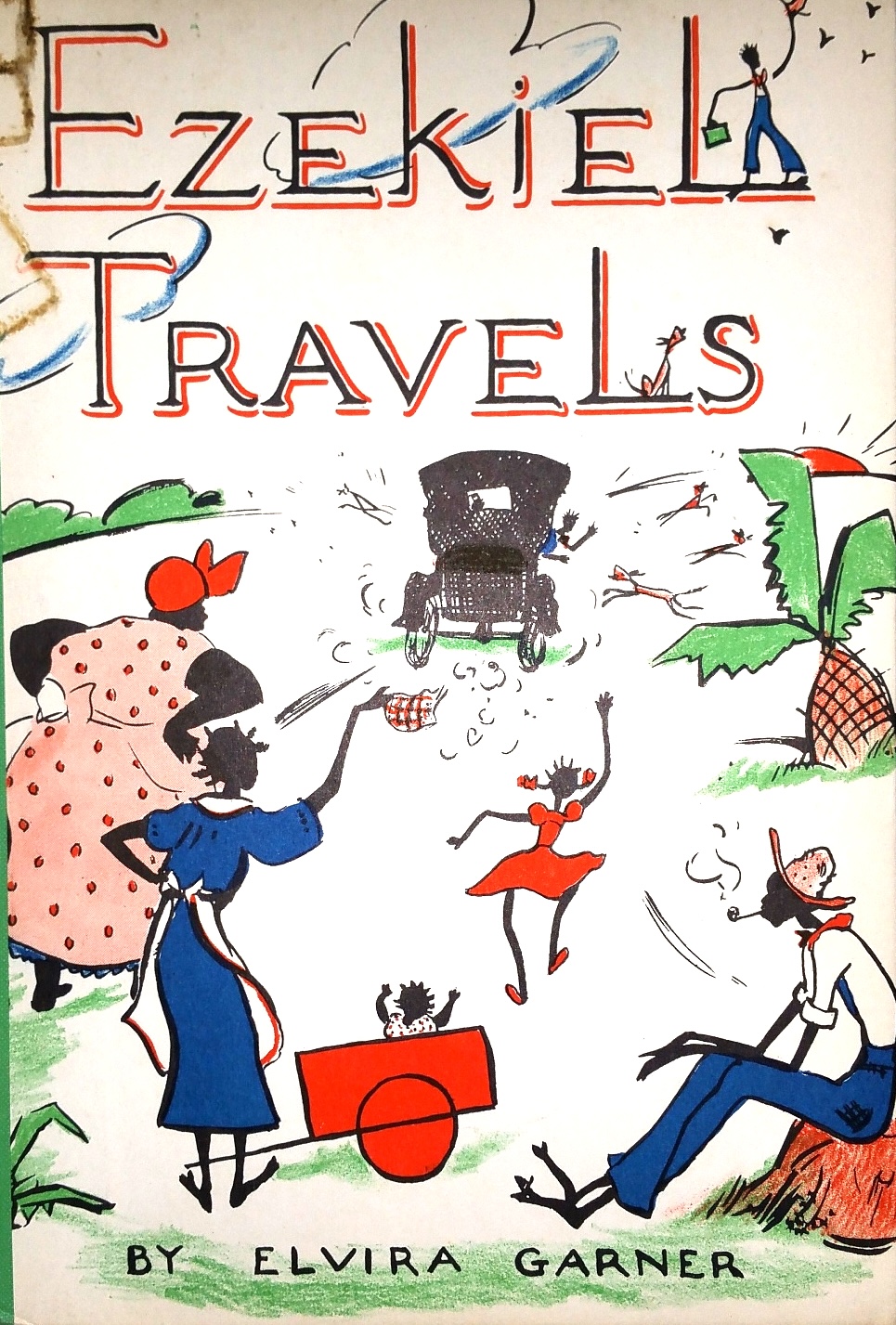
Of the literature of early 20th-century Florida, the late Marjorie Kinnan Rawlings and Zora Neale Hurston stand out for their ability to evoke disappearing Florida. However, there were other authors that spoke for that Florida landscape and folklore, including children’s author and illustrator Elvira Garner (1886-1956), the author of the book Ezekiel’s Travels.
Garner, a contemporary of both Rawlings and Hurston, is largely forgotten today, as her books were written in black dialect and were removed from library circulation after World War II. Her character Ezekiel and author Garner were both from Sanford, a small town north of Orlando that is now best known as the home of Auto-Train. The books, published in the 1930s, were geared towards first graders and illustrated inside and around with hand-drawn text, somewhat like a graphic novel of today.
As its original 1930s Kirkus Review explains it:
“Stories include ….[Ezekiel’s] search for the famous big tree which he had planned to bring home for Christmas; his hunt for Spanish gold, and the dazzling excitement of fair day at Orlando, all told with an endearing simplicity.”
Tennessee-born Garner’s work was not all about Ezekiel, though the book did bring her acclaim. Another Garner book featured a 19th-century girl, Sarah Faith Anderson. In that book, Sarah discovers historic St. Augustine and the Castillo San Marcos and tells of meeting local Indians.
Critic Tammy L. Miele defended Garner’s depictions of race in a 2006 literary thesis, saying that Garner showed typical family situations, including the difficulty of getting the family to an A.M.E. Church, and did not demean the characters through the dialect. Miele says that the books of Ezekiel were different from exploitation, as many of the issues involved the family’s poverty and segregation. In one part of his travels, for instance, little Ezekiel is unable to ride on the famous glass-bottomed boats of Silver Springs because he is black.
The main episode of Ezekiel’s Travels highlights a visit to the Senator Tree in what is now Longwood, a suburb of Orlando. The Senator Tree, just south of Sanford, was the fifth oldest tree in the world and the largest tree east of the Mississippi. It was named for state senator M.O. Overstreet, who gave it to Seminole County for a park. In 1929, President Calvin Coolidge saw the tree during an official visit, as it had become a famous tourist attraction.
Ezekiel learns about the tree from signs on his travels and hopes to get the tree to take it home to his parents at Christmas, saying, “Ah’ll follow de signs an git me dat big tree fur mah Chris’mus tree.”
But it is too big, so big that Ezekiel and his sister get tired of walking around it, and do not initially notice it.
About 15 years ago, I wrote about the tree on a Florida travel website, as I grew up with the book. While the story is no longer online, I saved many of the comments, as they helped me understand what the books, and the tree, meant to others. What I took for granted was that the tree would still be there, when and if I could get around to seeing it.
But in January of 2012, a drug addict named Sarah Barnes, smoking meth inside the tree, felt cold. She started a fire inside the tree’s ancient hollowed-out base. It caught the whole tree on fire and it burned to the ground. It was a fire so hot the local firemen could not stop it. Barnes is reported to have said at the time, “I can’t believe I burned down a tree older than Jesus.”
I had missed my chance to visit the great Senator Tree.
Barnes served 30 months and then got out, and was arrested again in 2019.
But the fire was not the end of the story. A decade before, a tree aficionado and science teacher named Layman Hardy had found a sprig of the tree and had taken it to nurseryman Marvin Buchanan, who cloned it. While most of the clones had died, a few had survived. Seminole County found out about it, and they relocated a survivor to the site.
If you are heading up Interstate 4 north of Orlando, the tree site is still worth a visit. There are picnic tables, the old fence, and some history plaques. And there is still, nearby, a cousin to the Senator, named Lady Liberty.
That cypress stands 89 feet tall, and is about 2,000 years old, putting the tree’s birth-date about the same time that Christ was born. Hardly unimpressive.